


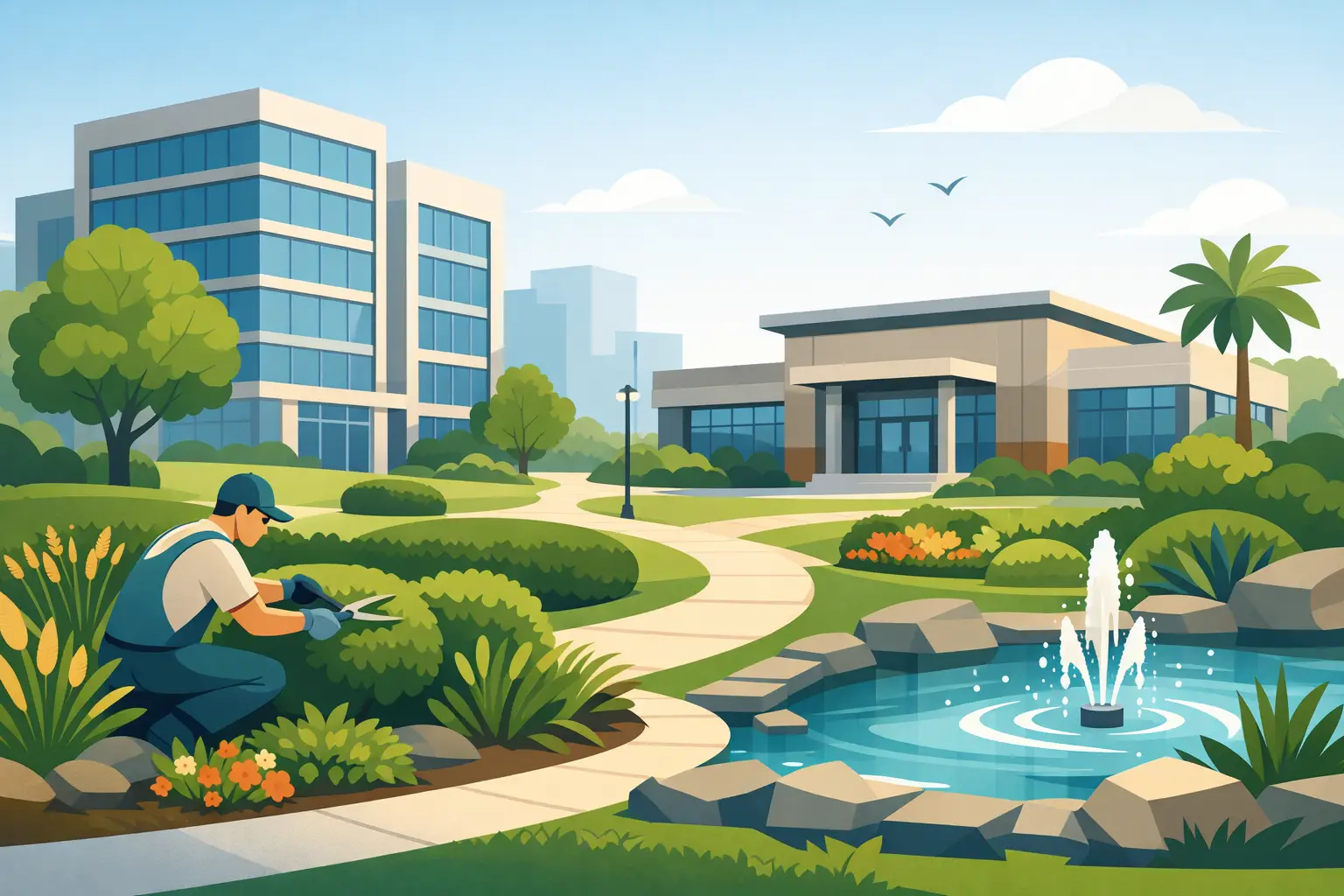
14 Jun Guide to Commercial Property Landscaping
A commercial property starts making an impression before anyone reaches the front door. The condition of the planting beds, the clarity of the walkways, the quality of the lighting, and the way the site feels as a whole all send a message. A strong guide to commercial property landscaping begins there – with the understanding that exterior design is not decoration alone. It is part of how a business presents itself, supports daily use, and protects long-term property value.
For property owners, developers, and managers, the real challenge is balancing appearance with performance. A landscape needs to look polished, but it also has to handle foot traffic, weather swings, drainage demands, seasonal change, and maintenance realities. The best results come from treating the landscape as part of the property’s infrastructure, not as an afterthought.
What commercial property landscaping is really meant to do
Commercial landscaping has a broader job than many people expect. Yes, it should improve curb appeal. But curb appeal is only one layer. On a well-planned site, landscaping helps guide visitors, softens hard architecture, creates safer circulation, manages water, frames signage, and gives the property a more established, professional identity.
That matters whether the site is an office building, retail plaza, condo development, hospitality space, medical office, or industrial property. Each use has different demands. A retail center may need stronger visual impact near entrances and road frontage. A professional office may benefit more from a composed, understated design that communicates stability and care. Multi-unit residential and mixed-use sites often need a blend of welcoming common areas, durable pathways, and planting that looks strong through multiple seasons.
Good commercial landscaping should also reduce friction. If visitors can find the entrance quickly, if snow storage has been considered, if plantings are not blocking sightlines, and if drainage is not undermining paving, the landscape is doing more than looking good. It is making the property function better.
A guide to commercial property landscaping starts with the site
No two commercial sites deserve the same plan. The property itself sets the terms. Sun exposure, drainage patterns, lot grading, soil quality, wind, access points, and surrounding architecture all shape what makes sense.
This is where many projects go off course. A design may look attractive on paper but perform poorly once installed because it ignores site conditions. Plant material that thrives in one location may struggle in another. Decorative features can become maintenance burdens if they are placed without thinking through use patterns or seasonal wear. Even a simple choice like bed layout can create problems if irrigation coverage, snow clearing, or pedestrian movement are not considered.
The strongest process starts with a detailed site review and a clear understanding of the property’s purpose. If the site needs to impress tenants, the entry experience deserves more investment. If the priority is reducing upkeep across a large footprint, the design should favor durable materials, efficient planting strategies, and cleaner bed lines. If stormwater is already an issue, drainage and grading cannot wait until later.
That kind of planning is where an experienced design-and-build firm brings real value. It reduces costly revisions and creates a landscape that holds up after the install is complete.
Design decisions that shape first impressions
Commercial landscapes work best when they feel intentional. That does not always mean elaborate. In fact, the most effective properties often rely on a restrained, well-composed design language.
Planting is one of the clearest examples. A layered planting plan with trees, shrubs, ornamental grasses, and perennials can create depth and seasonality without looking busy. But there is a trade-off. More diversity can bring a richer visual result, while simpler palettes are often easier to maintain consistently across larger sites. The right answer depends on the property type, budget, and maintenance standard the owner intends to uphold.
Hardscape choices matter just as much. Walkways, retaining walls, curbs, steps, and gathering areas should feel integrated with the architecture. On a commercial property, hardscape also takes more abuse than it would on a typical residential site. Materials need to be selected for durability, safety, and weather performance, not just appearance.
Lighting is another area where quality shows. Exterior lighting helps extend usability, improves safety, and highlights the strongest parts of the site after dark. The key is restraint and placement. Overlighting can make a property feel harsh. Thoughtful lighting creates clarity, comfort, and presence.
Budgeting for value, not just installation
One of the most common mistakes in commercial landscaping is focusing too narrowly on upfront cost. A lower initial number can look attractive, but it may lead to higher maintenance expenses, premature replacements, and an uneven appearance after only a few seasons.
A better approach is to evaluate the full life of the landscape. Durable paving, properly prepared bases, healthier plant stock, and better drainage details often cost more at the start. They also tend to protect the investment. The same is true of design decisions that simplify maintenance. Clean edges, realistic bed sizes, appropriate plant spacing, and material choices suited to the site can reduce labor demands over time.
There is no universal formula for how much to spend. A flagship office, a luxury multi-unit development, and a service-oriented industrial site will not have the same landscape priorities. What matters is aligning the budget with the role the exterior is expected to play. If the landscape is central to brand presentation and tenant experience, underfunding it usually shows.
Sustainability that works in the real world
Sustainability in commercial landscaping should be practical, not performative. The goal is not simply to add green elements. It is to make better choices that improve long-term performance.
That can mean selecting plant material suited to the local climate, reducing excessive turf areas, improving soil conditions, managing stormwater more intelligently, and using irrigation where it adds value rather than by default. Native and adaptive plantings can be a smart choice, but they still need to be matched to the site and maintained properly. Sustainable design is not a shortcut to no maintenance.
There is often a misconception that more naturalistic planting automatically lowers cost and effort. Sometimes it does. Sometimes it does not. A looser planting style can still require skilled seasonal care to look intentional rather than neglected. The best sustainable landscapes are the ones designed around how the property will actually be used and maintained.
Maintenance should be part of the plan from day one
A polished commercial landscape is not created at installation alone. It is shaped over time. That is why maintenance planning should be discussed during design, not after the work is done.
The question is simple: what standard does the property need to maintain? A premium office campus or high-visibility commercial frontage will usually require tighter upkeep than a back-lot service area. That affects plant selection, bed design, irrigation decisions, pruning expectations, and seasonal color strategy.
This is also where realistic decision-making matters. If ownership wants a refined, high-end look throughout the year, the maintenance plan and budget need to support it. If the available maintenance capacity is limited, the design should respond accordingly. There is nothing premium about installing a landscape that cannot be properly sustained.
Why execution quality matters as much as design
A strong concept can still fail in the field if the installation is rushed or poorly coordinated. Grades need to be accurate. Drainage has to work. Edges should be crisp. Materials should be installed to spec. Planting depth, spacing, and soil preparation all influence how the landscape establishes over time.
This is where craftsmanship becomes visible. You can see it in how paving lines meet, how walls sit, how planting beds are defined, and how the finished landscape relates to the building rather than competing with it. On commercial properties, those details carry weight because the site is read as part of the organization itself.
For owners and managers, working with one accountable partner from design through construction often simplifies the process. It helps protect the original vision and reduces the disconnect that can happen when planning and execution are split across too many parties. Firms with long-standing experience in custom outdoor environments, including teams like Redleaf Landscape Inc, tend to understand that the details are not extras. They are what make the finished property feel complete.
Choosing the right commercial landscaping approach
If you are planning a new commercial landscape or upgrading an existing one, the smartest first move is not choosing plants or materials. It is defining what the property needs to achieve. Do you want a stronger arrival experience, lower maintenance pressure, better tenant appeal, improved drainage, or a more cohesive exterior identity? Usually, the answer is a combination.
Once those priorities are clear, the landscape can be designed to support them with purpose. That is when commercial landscaping becomes more than surface improvement. It becomes a functional asset that strengthens the property from the street edge to the front entrance.
The best exterior spaces do not ask for attention. They earn it quietly, through quality, clarity, and care that people notice the moment they arrive.