


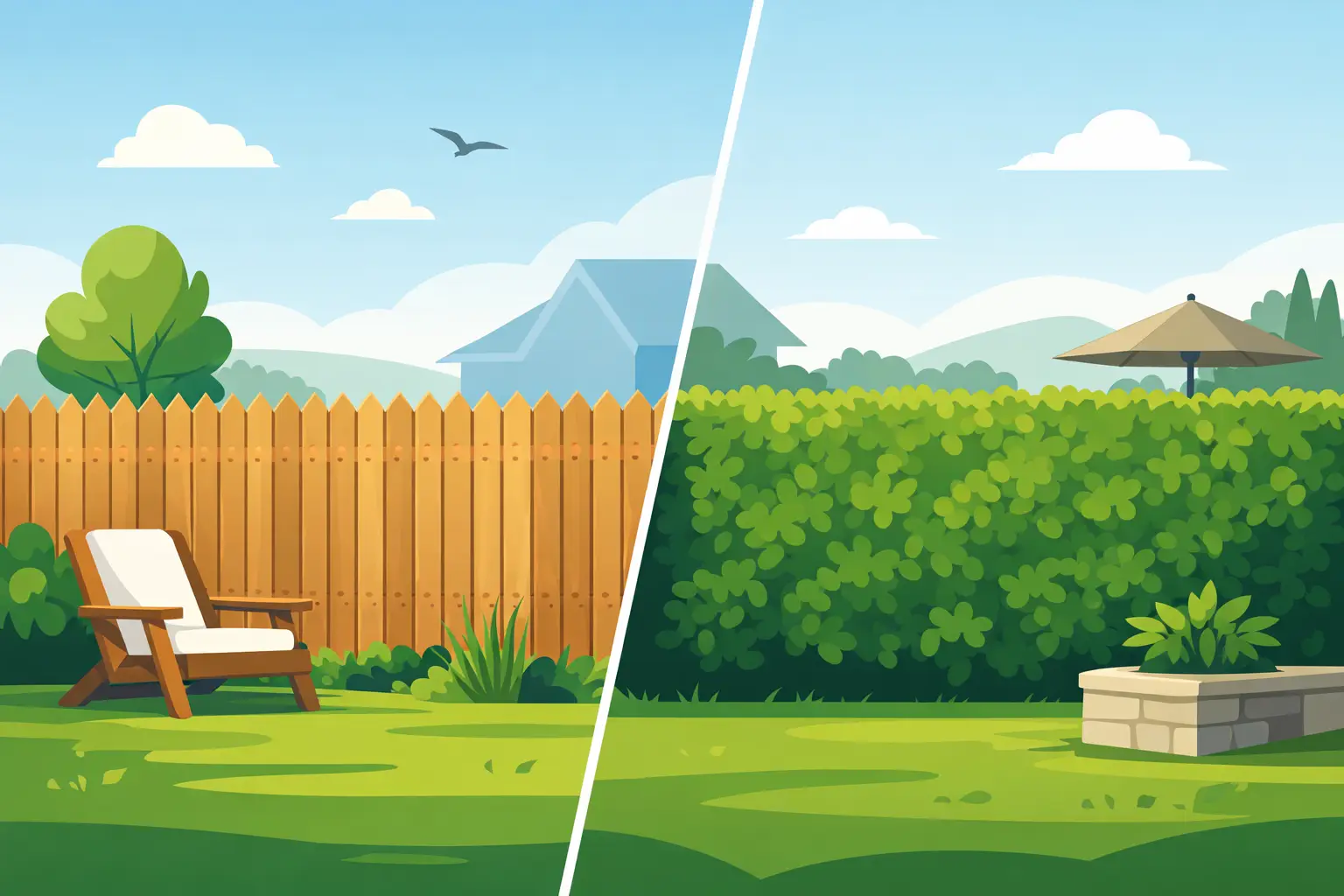
28 Jul Wood Fence vs Privacy Hedge: Which Fits Your Yard?
A backyard can have beautiful paving, a well-built deck, and thoughtful planting, yet still feel exposed if its edges are unresolved. The decision between a wood fence vs privacy hedge shapes more than what the neighbors see. It affects how you use the space, how quickly it feels finished, the maintenance it requires, and the overall character of your property.
For homeowners investing in a custom outdoor environment, the right choice is rarely based on privacy alone. A fence and a hedge create very different experiences. One delivers immediate structure and dependable screening. The other adds living texture, seasonal change, and a softer connection to the landscape. The better option depends on your site, priorities, and willingness to plan for the years ahead.
Wood Fence vs Privacy Hedge: The Core Difference
A wood fence is an architectural element. It establishes a clear property edge, creates an instant visual barrier, and can be designed to complement the home, deck, pergola, or garden. Once installed, it gives a yard a defined sense of enclosure.
A privacy hedge is a living boundary. It can filter views, absorb some street noise, soften hardscape, and bring depth to an otherwise flat property line. But it needs time, healthy growing conditions, and consistent care before it provides the same degree of screening as a solid fence.
Neither is automatically better. A narrow urban yard with close neighboring windows may benefit from the immediate privacy and efficient footprint of a fence. A larger property with room for layered planting may be better served by a hedge that contributes to a richer, more natural landscape design.
When a Wood Fence Is the Better Choice
Wood fencing is often the practical answer when privacy is needed now. A properly planned six-foot fence can block direct views as soon as construction is complete, which matters for homeowners who want to enjoy a new patio, pool area, dining space, or hot tub without waiting several seasons for plants to mature.
It also uses less ground space. A fence typically follows the lot line with a relatively slim footprint, preserving valuable square footage for a lawn, garden bed, seating area, or play space. This advantage is especially meaningful in established neighborhoods where yards are compact and every foot needs to work hard.
Design control and visual consistency
A custom wood fence can be tailored to the architecture of the property. Horizontal boards can create a clean, contemporary backdrop for modern planting. Vertical board-and-batten or framed panels can feel more traditional and refined. Cap details, gate design, staining, and integrated lighting can turn a basic boundary into a finished design feature.
Fencing also provides a strong backdrop for planting. Ornamental grasses, hydrangeas, evergreens, climbing vines, and perennial beds all read more clearly against a warm wood surface. Rather than treating the fence as a separate utility item, it can become part of a cohesive outdoor room.
What to expect from maintenance and longevity
Wood requires care, particularly in climates with freeze-thaw cycles, moisture, and intense summer sun. Posts, rails, and boards should be installed with drainage, proper spacing, and quality fasteners in mind. Periodic cleaning, staining, sealing, and repair help preserve both appearance and service life.
The material choice matters. Pressure-treated lumber is a common structural option, while cedar is often selected for its natural appearance and resistance to decay. Even a well-built wood fence is not maintenance-free, but careful craftsmanship at installation can prevent premature leaning, warping, and loose boards.
A fence can also feel visually heavy if it runs uninterrupted around the entire yard. This is where design makes the difference. A thoughtful layout can vary panel treatments, introduce planting pockets, use a feature screen near a seating area, or soften long runs with trees and layered shrubs.
When a Privacy Hedge Is the Better Choice
A privacy hedge is ideal when the goal is not simply to block a view, but to make the property feel greener, quieter, and more established over time. It can create a sense of separation without making the yard feel boxed in.
Hedges work particularly well along large side yards, rear property lines, and streetscapes where a solid fence might feel too abrupt. They can also improve the transition between a formal outdoor living area and the broader landscape, adding a living frame around the property.
A hedge adds more than screening
Evergreen hedges provide year-round coverage while contributing color and texture through every season. Deciduous hedges can offer flowers, fall color, and a lighter look, though they will not provide complete winter privacy. The right plant selection should reflect the amount of sun, soil conditions, drainage, wind exposure, and desired mature size.
A well-planned hedge can support a more sustainable landscape as well. It adds plant mass, offers habitat value, and can help reduce the stark heat reflection created by hard surfaces. For properties near a road, dense planting can also make the outdoor space feel more buffered from traffic and activity.
The trade-off is patience. Even substantial nursery stock will need time to knit together. Depending on the species, spacing, and starting size, a hedge may take several years to become dense enough for meaningful privacy. That timeline should be part of the initial design conversation, not an afterthought.
The maintenance commitment
A hedge needs regular watering during establishment, particularly through dry periods. It also needs pruning to retain its density, shape, and scale. If a hedge is allowed to become too wide or too tall, it can reduce usable yard space, crowd neighboring plants, and become difficult to renovate.
This does not mean hedges are high-maintenance by definition. The most manageable hedges are chosen for the site and given enough room to mature. Planting a large-growing evergreen in a narrow bed is not a low-maintenance solution, no matter how attractive it looks at installation.
For a polished residential landscape, hedge maintenance should be considered alongside lawn care, garden upkeep, and seasonal cleanups. A living screen performs best when it is treated as a long-term landscape feature, not a one-time purchase.
Compare Cost Beyond the First Installation
Initial cost matters, but it does not tell the whole story. Wood fencing can be a significant upfront investment, especially when the design includes premium lumber, custom gates, detailed trim, or complex grade changes. Its advantage is immediate performance: the privacy and enclosure are there from day one.
A hedge may cost less or more at the outset depending on the species, plant size, quantity, and site preparation required. Larger plants create faster impact but come at a premium. Irrigation, soil improvements, edging, mulch, and labor also contribute to the installed cost.
Over time, a fence may require staining, repairs, and eventual replacement. A hedge requires pruning, watering during dry periods, and occasional plant replacement if disease, winter damage, or poor drainage affects individual specimens. The better value is the option that supports your lifestyle without becoming a source of recurring frustration.
Privacy, Noise, and Security Considerations
For direct visual privacy, a solid fence is generally more dependable. It blocks sightlines at a predictable height and is especially useful around seating areas, pools, and side-yard passages. If privacy is the immediate requirement, it is difficult for young planting to compete.
A hedge can create a more gradual visual screen, but density varies by species and season. It may also take up more depth than a fence, which can be a disadvantage in smaller yards. On the other hand, the layered leaves and branches of a hedge can make a property feel less exposed from the street, even when it does not fully block every view.
Neither option is a complete sound barrier on its own. A solid, well-built fence can reduce some direct noise, while dense planting can soften the perception of a busy setting. For the strongest result, a fence combined with strategically placed evergreen planting often performs better than either feature alone.
Security is another practical factor. A fence creates a clearer physical boundary and can help contain children and pets when properly designed with secure gates. Before finalizing height, placement, and style, review local regulations, property-line requirements, utility locations, and any neighborhood rules that apply to your property.
The Best Answer May Be Both
Many of the most successful outdoor spaces use a fence and hedge together. The fence provides immediate screening, defines the lot line, and establishes the structure of the yard. Planting in front of it softens the view, adds depth, and makes the enclosure feel intentional rather than imposed.
This approach is particularly effective around patios and entertaining areas. A wood screen can protect the most private zone, while evergreens or mixed shrubs can extend the sense of seclusion along the rest of the property. The result is layered, functional, and more visually enduring than relying on one element alone.
The same principle applies to design style. A contemporary yard may pair horizontal cedar fencing with clipped evergreens and ornamental grasses. A more traditional property may use a warm vertical fence behind flowering shrubs, hydrangeas, and specimen trees. The boundary should support the landscape, not compete with it.
Start With How You Want to Live Outside
Before choosing materials or plant varieties, consider the moments the space needs to support. Are you looking for a private morning coffee spot, a secure family yard, a pool retreat, a more polished streetscape, or a generous setting for entertaining? Your answer will point toward the right balance of enclosure, greenery, and maintenance.
A carefully designed boundary does more than separate one property from another. It gives an outdoor space definition, comfort, and a stronger sense of place. When the fence, hedge, hardscape, and planting are planned as one composition, the result feels less like a backyard upgrade and more like a natural extension of the home.