


22 Jun How to Improve Yard Drainage Properly
After a heavy rain, the problem is usually obvious – pooling water near the patio, soggy turf that never seems to dry, mulch washing into the lawn, or a low corner of the yard that stays muddy for days. If you are wondering how to improve yard drainage, the right answer is rarely a single quick fix. Good drainage is a design issue, a grading issue, and often a construction issue all at once.
A well-drained yard does more than keep things tidy. It protects your foundation, preserves hardscaping, supports plant health, and makes the entire landscape more usable. For homeowners investing in a custom outdoor space, drainage should never be treated as an afterthought. It is part of the structure of the landscape, and when it is handled properly, everything above it performs better.
Why drainage problems happen in the first place
Most drainage issues come down to one of three causes: water is not being directed away properly, the soil is not absorbing water efficiently, or the yard includes low areas where runoff naturally collects. In many properties, it is a combination of all three.
Downspouts that discharge too close to the house can saturate planting beds and create wet zones along the foundation. Improper grading can send water toward a patio or garage instead of away from it. Heavy clay soil, common in many areas, drains slowly and tends to hold surface water. Even a beautifully finished yard can struggle if the base layers beneath the lawn, garden beds, or stonework were not built with water movement in mind.
There is also a practical reality that many homeowners discover late in the process: adding outdoor features changes drainage patterns. A new driveway, retaining wall, pool, or patio can redirect runoff in ways that did not exist before. That is why drainage planning needs to be integrated into the broader landscape design rather than addressed only after puddles appear.
How to improve yard drainage by identifying the real source
Before choosing a solution, it helps to understand where the water is coming from and where it should go. That sounds simple, but it is the step most often skipped.
Walk the property during or just after a rainfall. Look for where water gathers, how long it sits, and whether it is coming from your roof, your neighbor’s property, a slope, or a hard surface. Pay attention to patterns rather than isolated spots. A muddy patch in the lawn may actually be the endpoint of runoff starting much higher up the yard.
It also helps to distinguish between nuisance moisture and structural concern. A soft lawn area that dries in a day or two is different from standing water against the home, erosion near footings, or water that undermines pavers. The second category deserves prompt correction because the cost of waiting is usually higher than the cost of fixing it properly.
Regrading is often the most effective long-term fix
If the land is pitched the wrong way, surface drains and catch basins can only do so much. In many cases, regrading is the most effective answer because it solves the root problem instead of managing the symptom.
Proper grading creates a controlled path for water to move away from the house and into designated drainage areas. That may mean reshaping a lawn, adjusting bed elevations, or refining the slope around a patio or walkway. Done well, the change is subtle to the eye but significant in performance.
This is also where craftsmanship matters. Regrading should not leave the yard looking forced or uneven. In a premium landscape, functional grading has to blend into the design so the result feels natural, polished, and intentional. That balance is what separates a corrective patch job from a finished outdoor environment.
Improve downspout discharge before you do anything complicated
One of the simplest ways to improve yard drainage is to move roof water farther away from the home. If downspouts end at the base of the foundation or empty into beds that already stay wet, they may be contributing more than you realize.
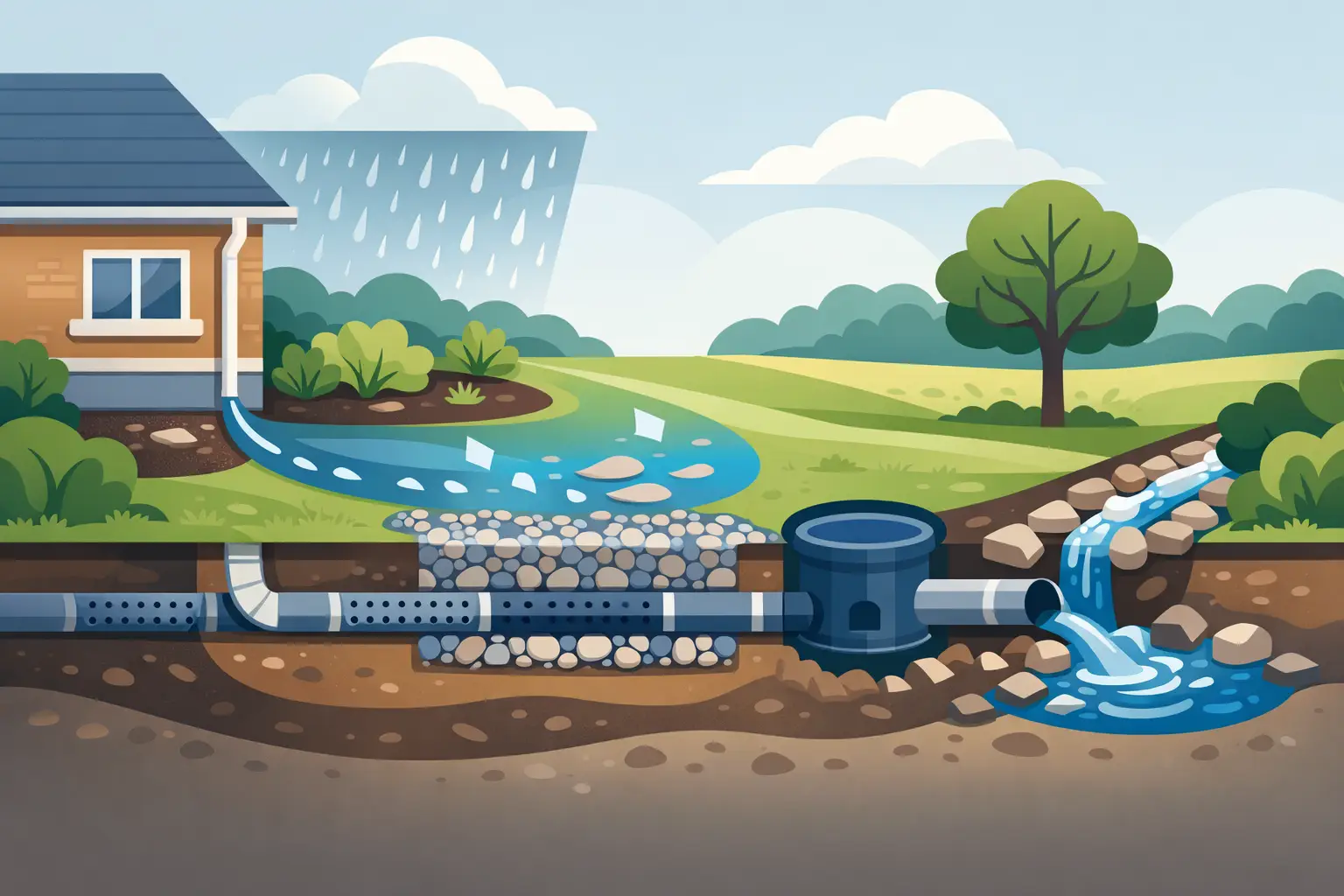
Extending downspouts can reduce saturation around the house and relieve pressure on surrounding lawn and planting areas. In some cases, buried drainage lines are the cleaner and more reliable option, especially when the goal is to preserve the appearance of the landscape. This approach works best when the discharge point is chosen carefully and local drainage rules are respected.
The trade-off is that downspout extensions alone will not solve a grading problem. They are valuable, but they work as part of a system, not as a substitute for one.
French drains and swales each solve different problems
Homeowners often ask whether they need a French drain. Sometimes the answer is yes, but not always.
A French drain is useful when water needs to be collected below the surface and redirected away from a consistently wet area. It typically involves a perforated pipe set in gravel that captures and channels subsurface water. This can be effective near foundations, along retaining walls, or in lawns with chronic saturation.
A swale is different. It is a shallow, shaped channel that guides surface water across the yard in a controlled way. Swales can be highly effective for larger properties or areas where water naturally flows after storms. They are often more visible than underground drains, but when designed well, they can be integrated into the landscape with a softer, more natural look.
The right choice depends on what kind of water you are dealing with. Surface runoff calls for one strategy. Persistent soil saturation may call for another. In some projects, both are needed.
Catch basins, channel drains, and patio drainage
Drainage becomes even more important when you have outdoor living features. Water that sits on a patio, around a pool, or at the base of steps is not just inconvenient. It shortens the life of materials, creates slip hazards, and affects how the space feels and functions.
Catch basins and channel drains are often used to intercept water at hardscape level before it spreads into surrounding areas. This is especially useful where the layout does not allow enough slope to move water naturally without affecting the design. A channel drain along the edge of a patio, for example, can preserve a clean, level entertaining space while still moving runoff efficiently.
What matters most is proper installation. Drainage components should be sized correctly, placed intentionally, and tied into a broader water management plan. Decorative surfaces may get the attention, but the unseen infrastructure determines whether the space performs year after year.
Soil, planting, and permeable surfaces can help
Not every drainage solution needs to look engineered. In some yards, improving soil structure, selecting moisture-tolerant plantings, or using permeable materials can make a meaningful difference.
Compacted soil limits infiltration, so amending planting areas can help water move more naturally into the ground. In low spots that cannot be eliminated completely, a rain garden may offer a more elegant solution than constant patching and re-sodding. Permeable pavers or gravel systems can also reduce runoff compared with fully impermeable surfaces.
That said, these are not universal fixes. If the yard has severe grading issues or water is backing up against the house, planting upgrades alone will not be enough. Softscape strategies work best when they support a sound drainage framework.
When a drainage problem calls for a full landscape plan
If your yard has repeated standing water, erosion, failing turf, or drainage issues around multiple features, piecemeal fixes can become expensive fast. A better approach is often to look at the property as a complete system.
That means evaluating grading, hardscape elevations, collection points, roof runoff, soil conditions, and the way each part of the landscape interacts with the others. For many homeowners, especially those planning a backyard renovation, this is the moment where working with an experienced design-and-build team adds real value. Drainage should be built into the project from the start, not added later as damage control.
For a company like Redleaf Landscape Inc, that level of planning is part of creating outdoor spaces that are not only beautiful, but durable, usable, and built with purpose. The visible finish matters, but the performance behind it matters just as much.
Common mistakes to avoid
The biggest mistake is treating standing water as a surface problem only. Replacing sod, adding gravel to a muddy patch, or installing one drain in the wrong location may improve appearances briefly without correcting the cause.
Another common issue is sending water somewhere else on the property without a proper outlet. Water always needs a destination. If it is redirected carelessly, the problem simply moves from one area to another.
Finally, avoid overcorrecting without a plan. Too much slope can create erosion and make outdoor spaces feel awkward. Too many drainage elements can clutter a clean design. The best results come from measured solutions that respect both function and form.
A yard should feel effortless when it is finished. Dry where it should be dry, green where it should be green, and ready to use after weather passes through. That is what good drainage really delivers – not just water control, but a landscape that performs as beautifully as it looks.