


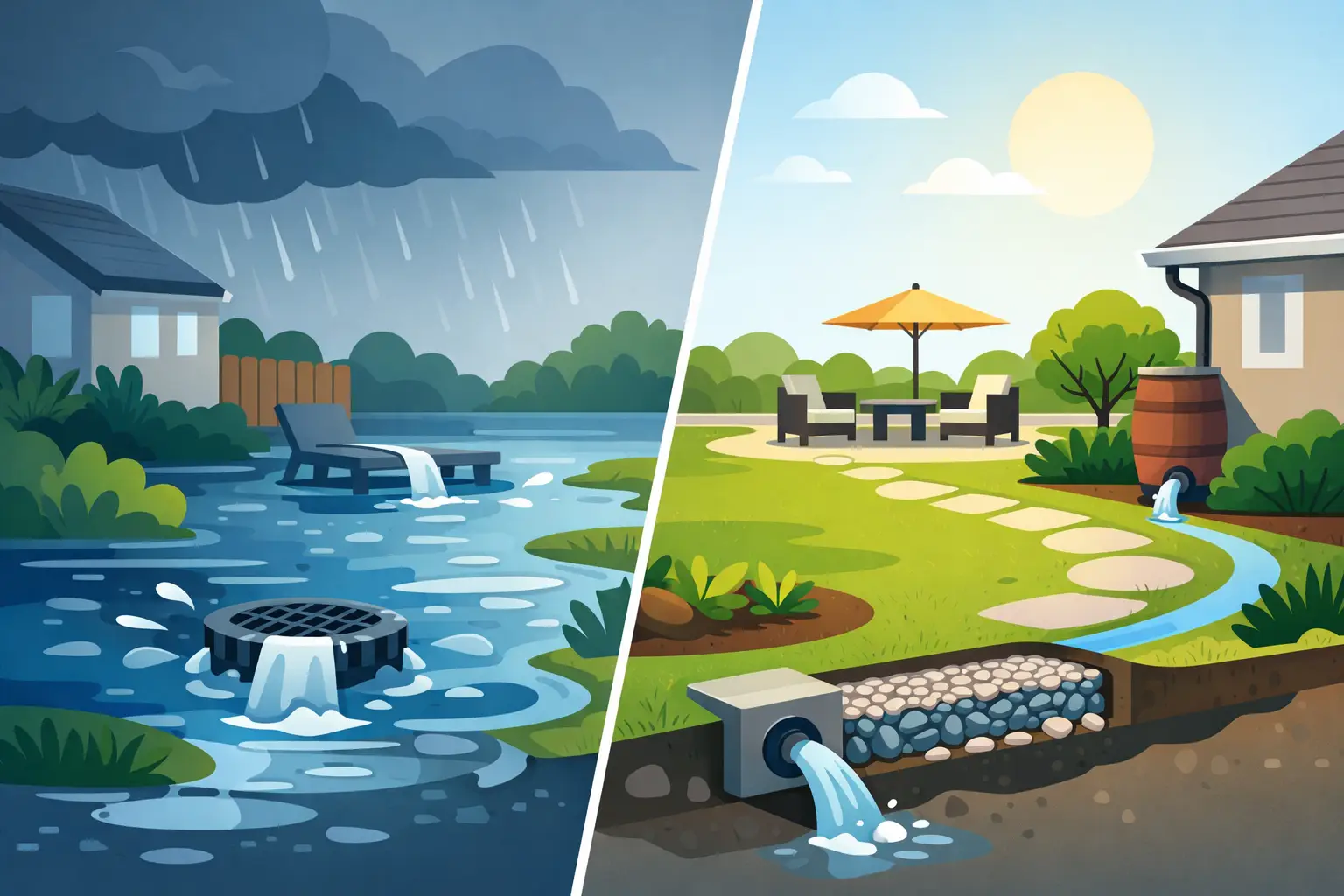
18 Mar How to Fix Backyard Flooding for Good
A backyard should feel like an extension of your home, not the part of the property you avoid after every heavy rain. If water sits for days, turns lawn areas to mud, or creeps toward your patio and foundation, the issue is rarely just cosmetic. Backyard flooding can damage hardscapes, weaken plantings, limit how you use the space, and create larger drainage problems over time.
The good news is that most flooding issues can be corrected. The right solution depends on why the water is collecting, where it is trying to go, and how your property is built.
How to fix backyard flooding starts with the cause
Many homeowners assume flooding means they need a drain. Sometimes they do. But drainage products only work when they match the actual problem.
Backyard flooding usually comes from one or more of these conditions: poor grading, compacted soil, low spots that trap runoff, water discharged from downspouts, hard surfaces that shed too much water, or neighboring properties that direct water into your yard. In some cases, a yard was simply never designed to manage stormwater properly in the first place.
That is why the first step is diagnosis, not excavation. Watch what happens during and after a steady rain. Notice where water first appears, where it pools longest, and whether it moves at all. A soggy area in the middle of the lawn points to a different fix than water collecting along the house or pouring off a driveway edge.
Start with grading before adding drainage systems
If the ground slopes toward your home or into a low pocket, water will keep collecting no matter how many surface fixes you try. Proper grading is often the most important part of how to fix backyard flooding because it changes the movement of water at the source.
A yard should gently direct water away from the house and toward a safe discharge area. That might be a swale, a drainage inlet, or another approved outlet depending on the property. Even subtle grading errors can create recurring wet spots, especially in newer neighborhoods where lots sit close together and runoff patterns are tight.
Regrading is not always a major rebuild, but it does require precision. Too little slope and the problem remains. Too much and water can rush too quickly, erode planting beds, or create new issues elsewhere. If your flooding affects a large section of the yard, grading is often the most effective long-term answer because it improves the performance of everything built on top of it.
When regrading makes the most sense
Regrading is usually worth considering when water ponds across broad lawn areas, when your patio stays wet around the edges, or when the yard feels generally uneven underfoot. It is also common when a property has had multiple rounds of piecemeal landscaping that never addressed drainage as a full system.
For homeowners investing in a premium outdoor living space, this matters even more. There is little value in installing new stonework, gardens, or turf over a drainage problem that will shorten the life of the finished project.
Improve soil conditions if water will not soak in
Not every flooded yard has a slope issue. Some hold water because the soil is too compacted or too clay-heavy to absorb rainfall at a reasonable rate. In these cases, the ground acts almost like a sealed surface.
If the lawn becomes soft and sticky after modest rain, or if puddles form even on fairly level areas, poor infiltration may be part of the problem. Aeration can help in minor cases. Amending soil with organic material may also improve drainage in planting areas. But for persistently saturated yards, soil improvement alone is rarely enough.
This is where homeowners need to be realistic. A simple lawn treatment will not solve a site-level drainage issue. It may improve surface conditions, but if the property collects runoff from roofs, patios, or adjacent lots, you will likely need a broader drainage strategy.
Use the right drainage system for the way water moves
Once grading and soil conditions are understood, drainage systems can manage the water that remains. The best choice depends on whether you are dealing with surface flow, subsurface saturation, or concentrated runoff.
A French drain is one of the most common answers when homeowners ask how to fix backyard flooding. It works well when water moves through the soil and needs a controlled path away from wet zones. A perforated pipe surrounded by clean gravel collects and redirects water before it sits too long in the yard.
A catch basin or area drain is better for surface water that gathers quickly in a low spot. It captures runoff at the top and channels it into underground piping. This can be especially useful near patios, walkways, and the base of slopes where water visibly collects.
Channel drains are often used along hardscape edges, such as the border of a patio, pool surround, or driveway, where sheet flow needs to be intercepted before it spreads. Dry wells can also help in the right conditions by giving runoff a place to disperse underground, though they depend heavily on soil performance and available space.
There is no universal best option. A French drain installed in the wrong location may do very little. A catch basin without proper grading into it will be ignored by the water entirely. Good drainage design is less about the product and more about how each piece supports the overall movement of water through the site.
Do not overlook downspouts and hard surfaces
Some of the worst flooding problems begin with roof water. If downspouts empty too close to the home, into planting beds, or onto already saturated lawn areas, they can overwhelm the yard fast. During a major rain, a single roof section can send a surprising volume of water into one concentrated area.
Extending downspouts into a buried drainage line is often one of the most effective upgrades on the property. The key is sending that water to an appropriate discharge point, not just moving it a few feet away.
Hard surfaces matter too. Patios, driveways, and walkways increase runoff because they do not absorb water. If those surfaces were built without careful pitch, they can funnel water directly into your lawn or toward the foundation. In some cases, flooding is the result of excellent-looking hardscaping installed without enough attention to drainage details.
That trade-off is worth understanding. A beautiful outdoor space should not only look refined on installation day. It should perform after years of storms, freeze-thaw cycles, and seasonal use.
Consider landscape solutions that work with drainage
Not every flooding issue calls for a purely mechanical fix. In the right yard, landscape elements can support drainage while improving the design of the property.
A swale, for example, is a shallow, shaped depression that guides water across the site in a controlled and visually integrated way. When designed well, it does not feel like a ditch. It feels like part of the landscape. Rain gardens can also help in areas where temporary water collection is acceptable and carefully planted for that purpose.
Permeable pavers are another strong option when replacing or building hard surfaces. They allow water to move through the surface and into a prepared base below, reducing runoff and helping with stormwater management. They are not right for every application, but in the right setting they combine appearance, performance, and long-term value.
This is often where custom landscape design has the greatest impact. Instead of treating drainage as an add-on, it becomes part of the structure and beauty of the yard from the beginning.
When backyard flooding needs professional intervention
If water is affecting your foundation, entering a basement, killing large lawn sections, or repeatedly damaging hardscape areas, it is time to approach the problem as a construction issue rather than a weekend project. The same is true if the flooding involves multiple causes, such as roof runoff, poor slope, and neighboring drainage all at once.
A professional drainage plan should look at the entire site, not just the wettest corner. That includes elevations, surface materials, discharge points, and how water interacts with the spaces you actually want to use. For homeowners making a larger outdoor investment, that kind of planning protects both usability and finish quality.
For properties in the GTA, Redleaf Landscape Inc approaches drainage the same way it approaches every outdoor environment – with attention to detail, quality in craft, and a focus on long-term function as well as appearance. When drainage is solved properly, the yard does more than dry out. It becomes usable, cohesive, and built to support the way you want to live outside.
Backyard flooding is frustrating, but it is rarely random. Water follows grade, pressure, and path. Once those are understood, the fix becomes much clearer – and a well-designed landscape can turn a problem area into one of the strongest parts of the property.