


17 Mar Drainage Solutions for Yards That Last
A beautiful yard stops feeling luxurious the moment water starts dictating how you use it. One heavy rain, and the lawn turns soft underfoot, patio edges stay slick, garden beds wash out, and that one low corner never seems to dry. Poor drainage is not just a nuisance. It limits how a property functions and slowly works against the investment you have made in it.
The right fix is rarely a single product dropped into the ground. Effective drainage solutions for yards are usually part of a broader landscape strategy, one that manages water while preserving the look, flow, and character of the space. When done well, drainage is almost invisible. You notice the result in how the yard performs, how clean the lines stay after a storm, and how much easier it is to enjoy the space year-round.
Why yard drainage problems should be addressed early
Water is persistent. It will always follow slope, seek the lowest point, and exploit weak spots in grading or construction. That is why drainage issues tend to grow rather than resolve themselves. A soggy lawn can become thinning turf. Mulch migration can turn into exposed roots. Standing water near a home can put pressure on foundation walls, contribute to basement moisture, and shorten the life of hardscape surfaces.
There is also the issue of usability. Homeowners invest in outdoor living spaces to create something that feels finished and personal, not something that can only be used two days after a storm. If a walkway puddles, a seating area holds water, or a side yard becomes muddy every spring, the space is not performing at the level it should.
In many cases, the drainage problem is not where the water appears. The puddle is simply where the issue becomes visible. The real cause may be improper grading, compacted soil, roof runoff, undersized drainage lines, or a hardscape installation that never accounted for water movement in the first place.
The most effective drainage solutions for yards
There is no universal fix because every property handles water differently. Lot slope, soil conditions, existing structures, and how the yard is used all matter. The best results come from matching the solution to the source of the problem.
Regrading for proper water flow
Grading is often the foundation of every successful drainage plan. If the land does not direct water away from the home and toward a safe discharge point, other measures may only provide partial relief. Regrading adjusts the slope of the yard so water moves naturally rather than collecting in low areas.
This can be a subtle correction or a more involved reshaping of the site. The trade-off is that grading work may affect lawn areas, planting beds, or adjacent features during construction. Still, when drainage issues stem from poor elevation changes, grading is usually the most durable long-term solution.
French drains for subsurface water
A French drain is designed to intercept and redirect water below the surface. Typically built with gravel and perforated pipe, it collects groundwater and moves it away from saturated areas. This is often useful where water lingers in lawn sections, along foundations, or near retaining walls.
French drains can be highly effective, but they are not a cure-all. If installed without the correct slope, pipe placement, or outlet, they can underperform. They also need to be integrated carefully into the landscape so they solve the issue without disrupting the finished appearance.
Catch basins and channel drains for hardscape areas
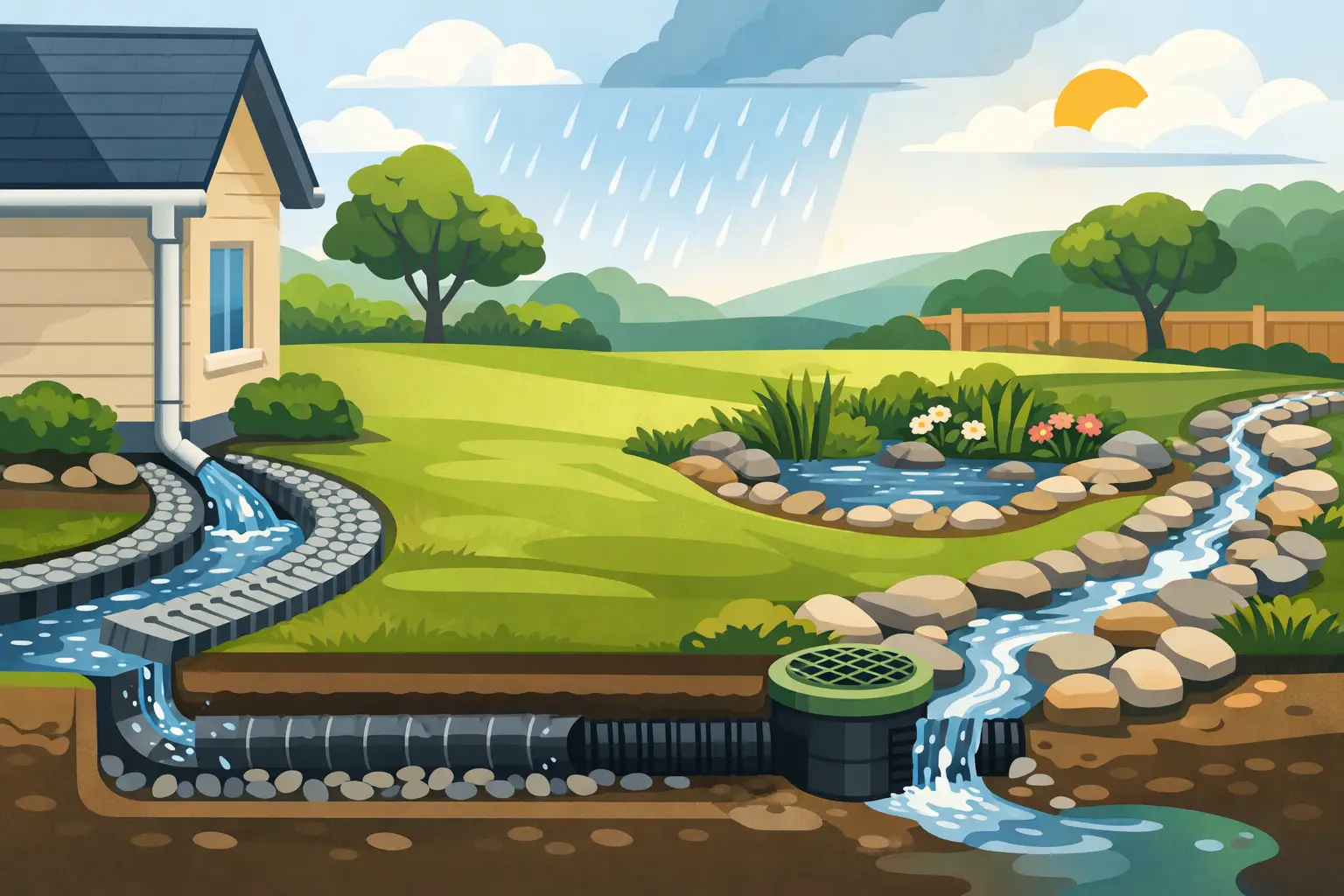
Where water gathers quickly on patios, driveways, pool decks, or walkways, surface collection systems are often the right answer. Catch basins collect water at low points, while channel drains capture runoff across a wider linear area.
These systems are especially valuable in outdoor living spaces, where standing water is both a practical and aesthetic problem. A well-designed patio should shed water cleanly and comfortably. If the finished surface is level in the wrong places or pitched toward the house, no amount of wishful thinking will change the result.
Downspout extensions and roof runoff control
Some of the most damaging yard drainage issues begin at the roofline. A large volume of rainwater discharged too close to the house or into a planting bed can overwhelm the area quickly. Extending downspouts, connecting them to underground drainage lines, or directing water to an appropriate discharge zone can make a significant difference.
This is often one of the simpler fixes, but it depends on what happens after the water leaves the downspout. If it is redirected into another weak area of the yard, the problem simply moves.
Dry creek beds and drainage swales
For properties that need both water management and visual integration, swales and dry creek beds can be strong options. A swale is a shallow, sloped channel that guides water through the landscape. A dry creek bed does the same while introducing stone, texture, and a more naturalized design feature.
These solutions work best when they are intentional parts of the landscape plan, not decorative afterthoughts. Done properly, they can soften the look of drainage infrastructure while supporting a cohesive outdoor design.
Permeable surfaces and soil improvement
Sometimes the issue is not only where water goes, but how little of it can soak in. Compacted soil and overly dense surfaces increase runoff and reduce absorption. Permeable pavers, gravel systems, and targeted soil amendment can help the yard handle water more naturally.
This approach is particularly useful in spaces where sustainability and long-term landscape health are priorities. It is not always enough on its own for severe drainage issues, but it can be an important part of a broader system.
Signs the problem is bigger than a quick fix
A splash block or a shallow trench may help in minor situations, but some warning signs point to the need for a more comprehensive plan. If water is pooling near the foundation, the lawn remains saturated for days, patio joints are shifting, erosion keeps returning, or runoff is affecting neighboring areas, the problem deserves a professional assessment.
The same is true if multiple symptoms are appearing at once. A wet lawn, failing garden edge, and standing water beside the house often share a common cause. Treating each symptom separately can cost more over time than addressing the full drainage picture from the start.
Design matters as much as drainage performance
The strongest drainage work protects the property without making the yard feel engineered or compromised. This is where design and build quality matter. A drain cover that disrupts a clean patio layout, a swale that looks accidental, or regrading that leaves the lawn awkward and unfinished does not meet the standard of a truly well-resolved outdoor space.
For higher-end residential landscapes and professionally presented commercial properties, drainage should support the overall vision. It should preserve usable square footage, maintain visual harmony, and work with planting, stonework, and circulation patterns rather than against them.
That is why drainage is best considered early in the planning process, especially for major landscape renovations. Waiting until after a patio, retaining wall, or outdoor kitchen is installed limits the options and can lead to costly rework. When water management is built into the design from the beginning, the finished result performs better and looks more refined.
Choosing the right partner for yard drainage work
Drainage is one of those areas where experience shows. Proper slope calculations, knowledge of soil behavior, understanding of local conditions, and careful installation all matter. So does accountability. On a custom property, the goal is not simply to move water somewhere else. The goal is to resolve the issue in a way that protects the home, supports the landscape, and feels fully integrated.
That level of work usually requires more than a patch solution. It calls for a team that can evaluate the site, identify the real cause, and build a drainage strategy that complements the property as a whole. For homeowners and property managers who want lasting results, that is the difference between repeated repairs and a yard that finally works the way it should.
At Redleaf Landscape Inc, drainage is approached as part of the larger craft of building outdoor spaces that are both beautiful and functional. That means solving water issues with the same attention to detail applied to every other part of the landscape.
If water is limiting how you use your yard, the answer is not to work around it season after season. The right solution restores confidence in the space and lets the landscape perform with the level of quality your property deserves.